6 Easy Math Games for Kids Using Dice and Everyday Supplies
Turn number practice into a pretend shop, a build-and-compare challenge, or a dice adventure—with easy ways to adjust the difficulty.
By Buybili Editorial Team Published October 2, 2026 7 minutes
“Let’s do math” and “Let’s open a toy shop” can lead to the same numbers, but feel very different. Everyday objects give children something to move, compare, and talk about while they work out an answer.
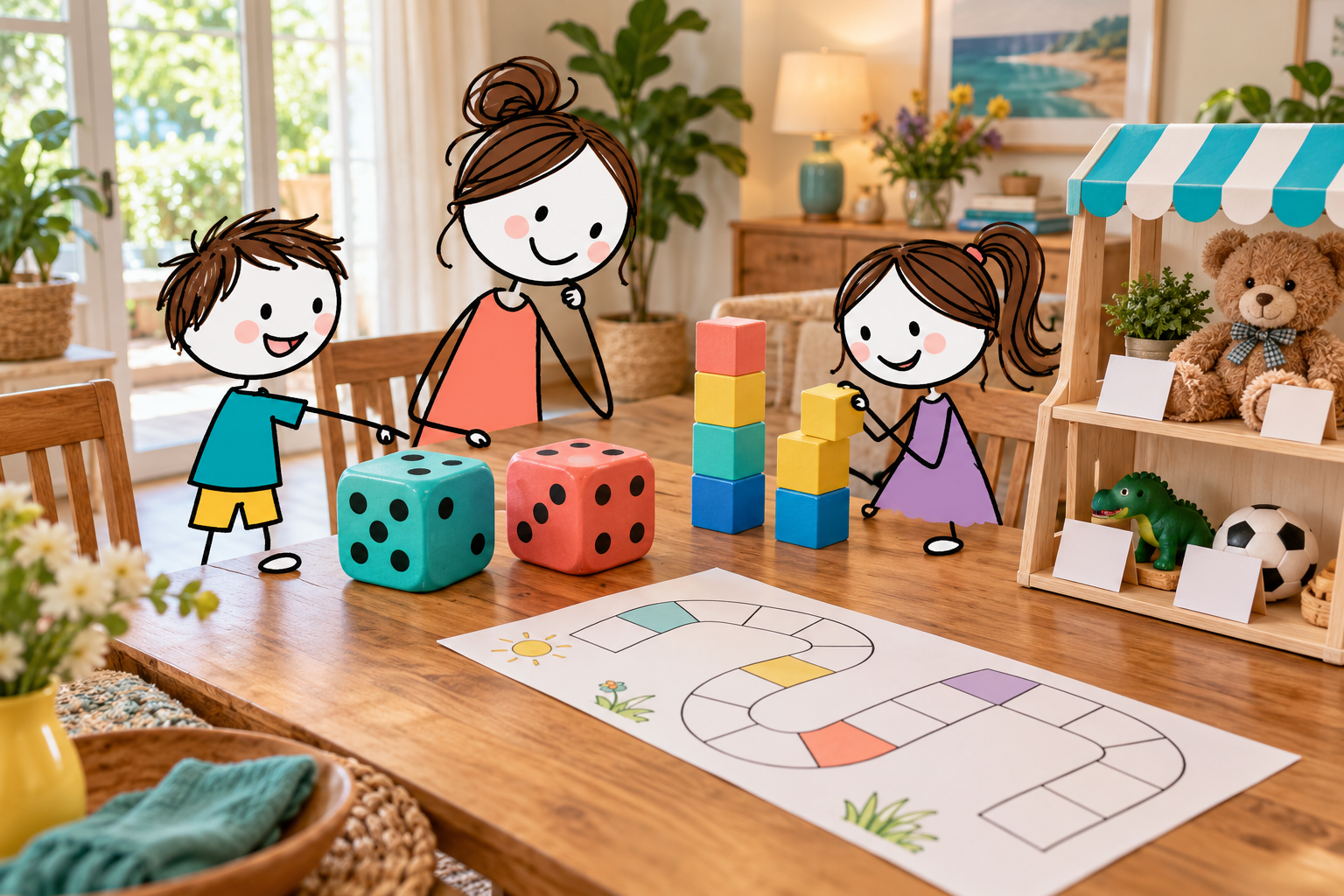
These games suit a range of abilities, roughly ages 4–9. Start with the easiest version and increase the challenge only if your child wants it. Use an oversized die or adult-made number cards if smaller dice could pose a choking risk to anyone nearby.
| Game | Easier version | More challenge |
|---|---|---|
| Number-path adventure | One die; count steps | Two dice; add first |
| Build and compare | Compare short towers | Find the difference |
| Make a number pair | Make 5 | Make 10 or 20 |
| Toy-shop shopping | One item | Combine two prices |
| Shape detectives | Find a shape | Explain its properties |
| Fair-share picnic | Share four objects | Explore leftovers |
1Take a number-path adventure
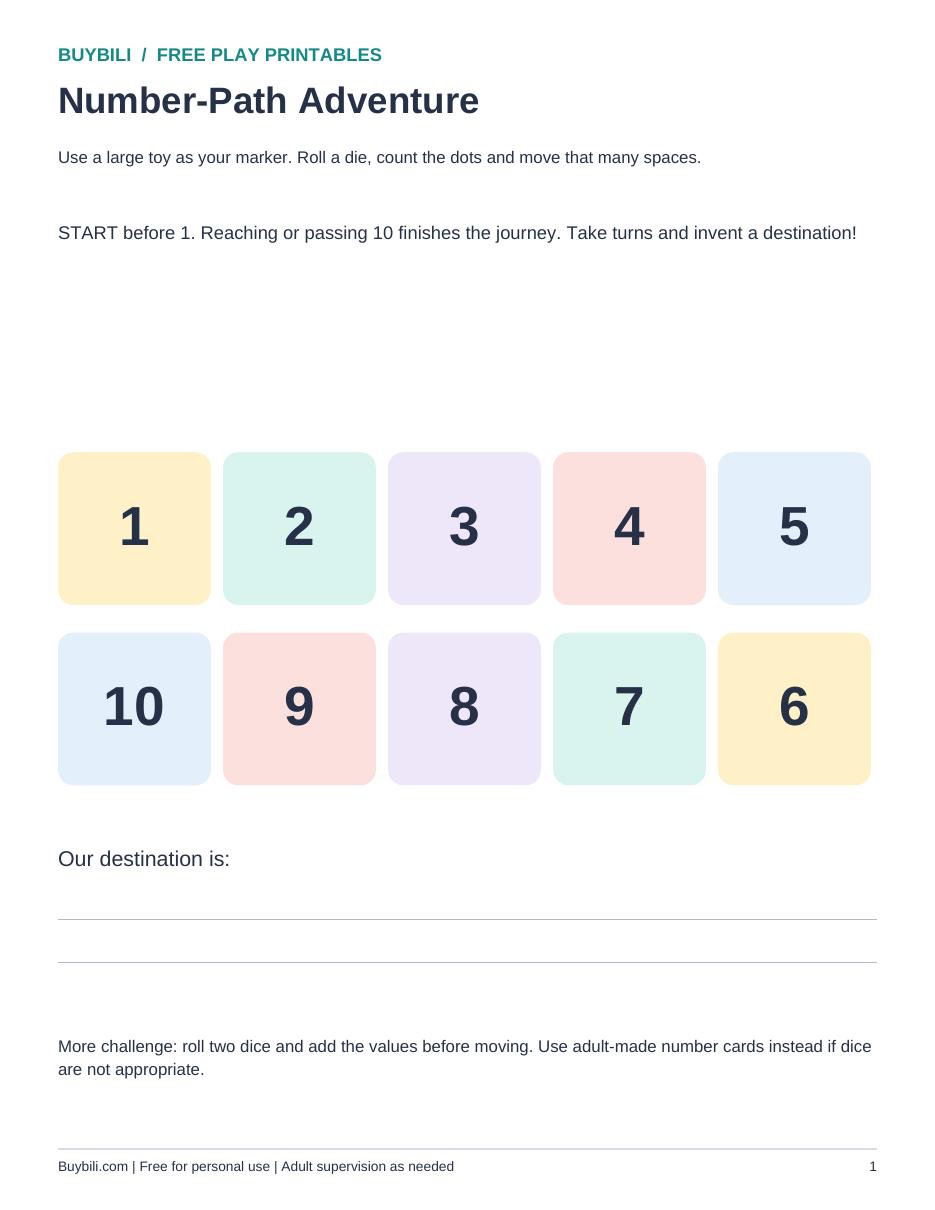
Draw a path with ten spaces on paper. Each player chooses a large toy as a marker. Roll, count the dots, and move that many spaces.
Agree in advance that reaching or passing the last space finishes the journey. Take turns describing the imaginary destination, so nobody needs to be eliminated.
More challenge: Roll two dice, add the values, then move. Help your child count dots or use objects when useful.
2Build and compare
Each player rolls and builds a tower with that many large blocks. Put the towers beside each other and ask, “Which has more blocks? How can we check?”
Compare counts, not just height—different blocks can make towers misleading. Line blocks up one-to-one if the answer is unclear.
More challenge: Find how many blocks would make the towers equal.
3Make a number pair
Choose a target of five. Put five large blocks on the table. Split them between two paper circles and describe the groups: “Two here and three there.”
Move one block and name the new pair. How many different ways can you find? Both an empty group and a full group are allowed.
More challenge: Use ten blocks and write the matching addition sentence.
4Run a toy shop
Set out toys with simple pretend prices from one to five. Make large paper payment cards, each worth one pretend coin.
Your child chooses an item and counts out payment. Swap roles so they become the shopkeeper. There is no need for real money or purchases.
More challenge: Buy two items and combine the prices. If ready, pay with a ten-value card and work out change together.
5Become shape detectives
Search for a circle, triangle, rectangle, and square in everyday objects. Look at flat faces and outlines: a clock face may be circular, while the whole clock is a three-dimensional object.
Draw your discoveries. Can your child find a square and explain how it also fits the description of a rectangle? A square has four right angles and four equal sides; rectangles have four right angles.
More challenge: Compare flat shapes with solid objects such as a cube-shaped box or ball.
Make room for thinking
When an answer is unexpected, ask, “Can you show me?” Let your child use blocks, fingers, drawings, or dot counting. The aim is to explore the numbers together, with a challenge that feels inviting rather than a race to finish.
Free Printable
Get Your Free Math Games Pack
Print three pages: a ten-space number path, a number-pair mat, and pretend price cards. Use large toy markers, blocks, and age-appropriate dice. On the number path, start before space 1. The pack accompanies three of the six games; the others use everyday objects.
Print on US Letter paper. For A4, choose Fit to Printable Area. Free for personal use.
Paper printable for handwriting; not an interactive PDF form. 3 pages.