5 Easy Sensory Play Ideas at Home: Little Setups, Big Possibilities
A toy wash, a paper rainstorm, a dough bakery: five playful ways to explore everyday materials without turning your house upside down.
By Buybili Editorial Team Published October 2, 2026 7 minutes
Sensory play does not need a giant bin, expensive kit, or floor covered in rice. A few interesting materials and one clear invitation—“What can you do with this?”—are enough to begin.
These ideas are designed for children roughly ages 4–8, with an adult nearby. Younger children need different materials and closer supervision. Start with one activity, keep the setup small, and let your child decide whether to touch, watch, or use a tool.
| If your child wants… | Try… | Setup |
|---|---|---|
| Water and pouring | Toy-wash station | 5 minutes |
| Squishing and shaping | Pretend dough bakery | 5 minutes |
| Sounds and movement | Paper rainstorm | 2 minutes |
| Looking without messy hands | Window color lab | 3 minutes |
| A quiet guessing game | Texture detective | 3 minutes |
1Open a tiny toy-wash station
You need: A shallow tray, a little water, a cloth, and two or three large washable toys.
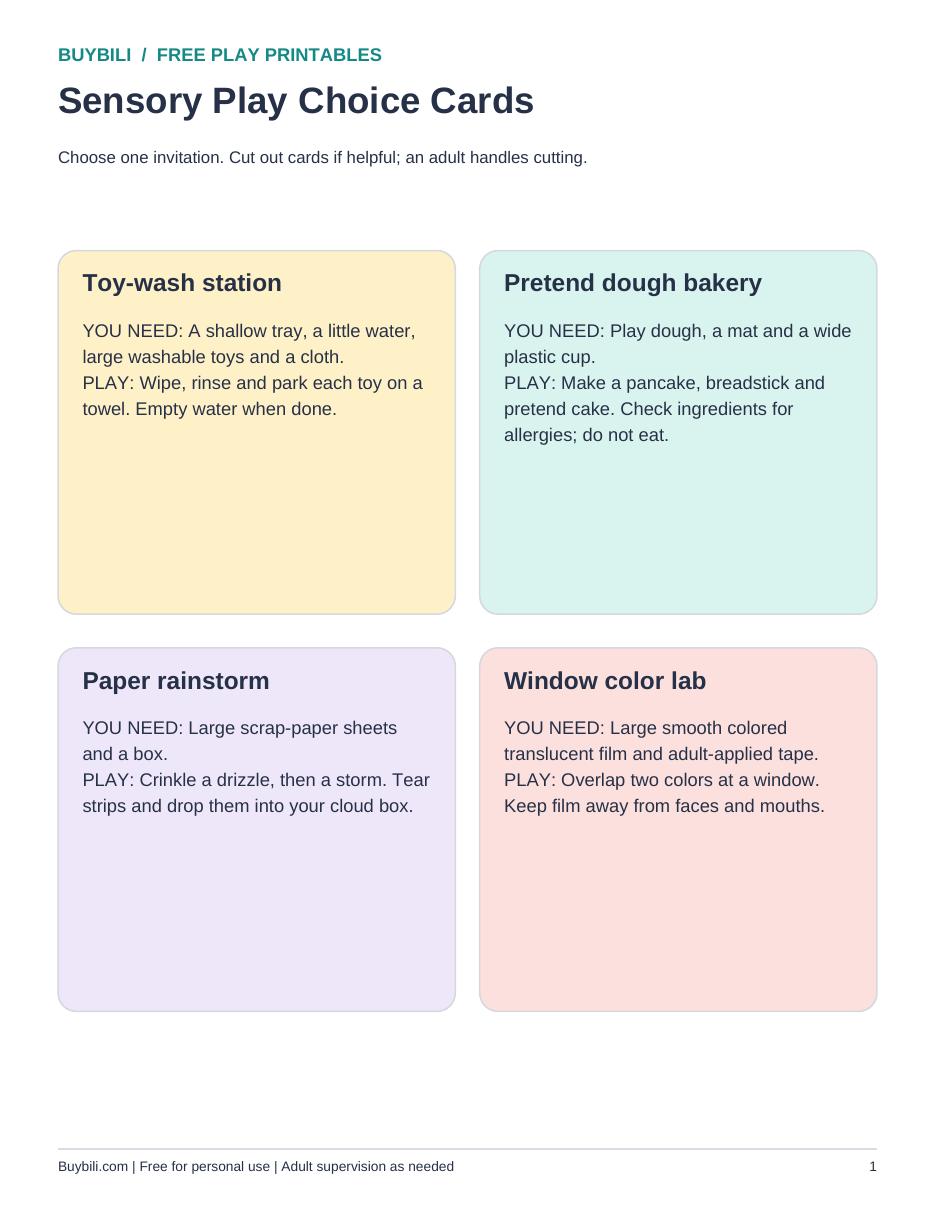
Place the tray on a towel. Invite your child to run a washing service: wet the cloth, wipe a toy, rinse, and park it on a dry towel. Make up silly customers: “This dinosaur would like clean feet, please.”
Add a pouring challenge with a plastic cup: can they pour slowly enough to keep the water inside the tray? Skip electronics and toys that trap water. Empty the tray when finished; do not leave children alone with water.
Less mess: Use a damp cloth and no standing water.
2Start a pretend dough bakery
You need: Age-appropriate play dough, a washable surface, and a wide plastic cup for stamping.
Make three imaginary orders: one long breadstick, one flat pancake, and one cake with finger-made decorations. Then swap roles so your child gives you an order.
There is no perfect shape. Flatten, roll, poke, rebuild. Choose dough ingredients appropriate for your household’s allergies and remind children that this dough is for play, not eating.
No-touch option: Press the dough with the bottom of a cup.
3Make a paper rainstorm
You need: Large sheets of scrap paper and an empty cardboard box.
First, crinkle paper quietly for a drizzle. Next, crinkle louder for a storm. Tear long strips and drop them into the box for falling rain. Let your child conduct the weather with “quiet,” “loud,” and “stop.”
Finish by filling the box together. Avoid paper staples and sharp edges. Keep scraps away from children who mouth objects.
4Build a window color lab
You need: Large pieces of colored translucent craft film, a window, and adult-applied removable tape.
Attach two colors side by side, then overlap them. Ask what changes when daylight passes through. Move the pieces higher or lower and compare the colors on a white sheet of paper.
Check that the film has smooth edges. Keep it away from faces and out of reach of children who might put it in their mouths.
5Become texture detectives
You need: A towel, smooth wooden spoon, clean sponge, and soft fabric square.
Let your child look at and handle the objects. Pick one secretly, describe it with two clues, and ask them to point to the match: “Soft and bumpy.” Then let them invent clues for you.
Eyes stay open—there is no need for a blindfold or surprise touching. If one texture feels unpleasant, take it out.
Keep the invitation small
Five minutes of enjoyable exploration is a good place to stop. Let your child help choose tomorrow’s material, and keep cleanup part of the game: the bakery closes, the washing service parks its toys, and the rain goes back into its cloud box.
Free Printable
Get Your Free Sensory Play Cards
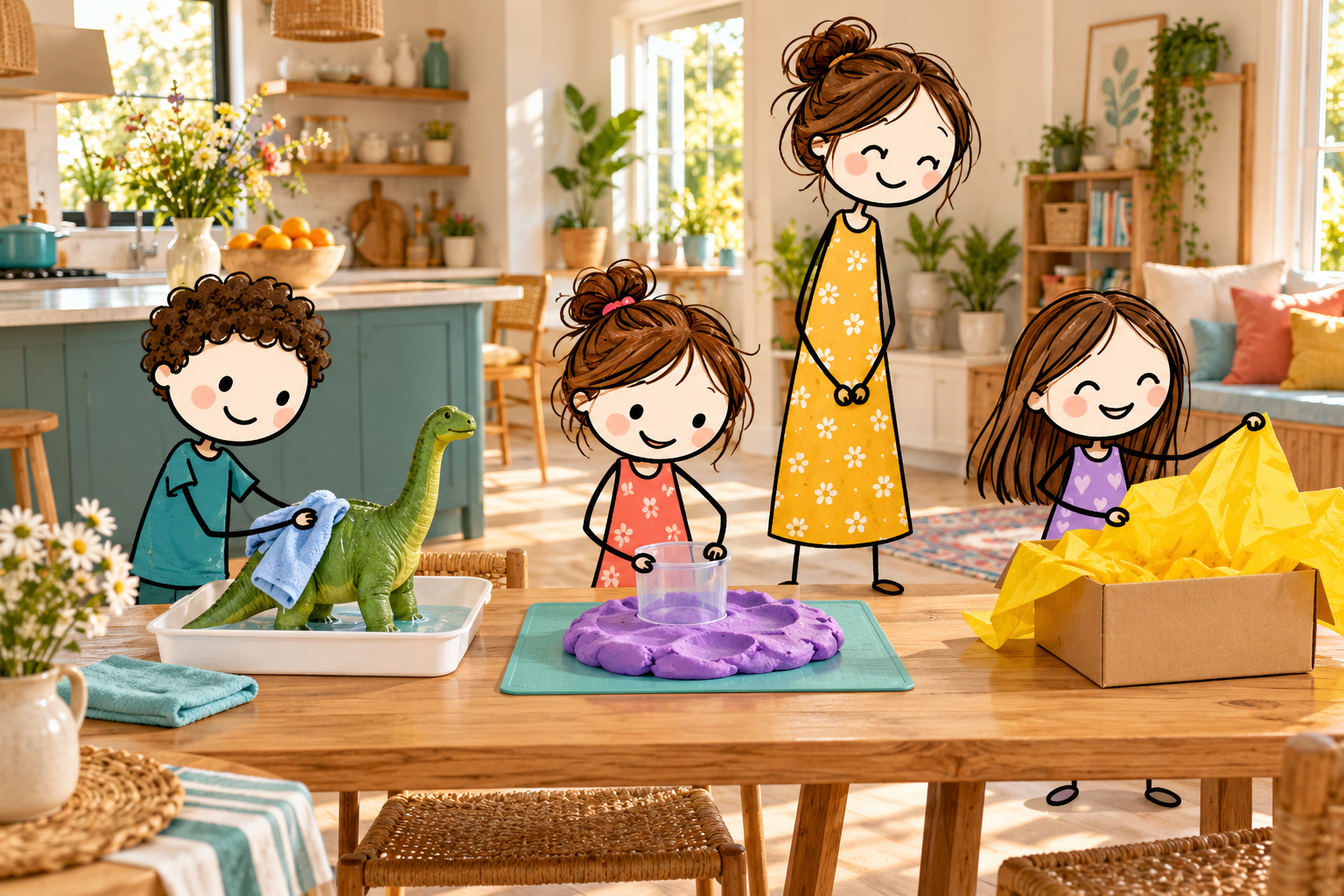
Print the two-page pack for five play invitations and a simple reflection sheet. Choose a card together before setting up; you still need the household materials listed on that card.
Print on US Letter paper. For A4, choose Fit to Printable Area. Free for personal use.
Paper printable for handwriting; not an interactive PDF form. 2 pages.